
Keyword research for B2B exporters is different from keyword research for an online shop or a local business. Search volumes are smaller, buyers use technical and regional vocabulary, and a single query with only fifty searches a month can be worth more than a consumer keyword with fifty thousand, because one of those fifty searchers may place a container order. Yet many exporters still choose keywords by translating their Chinese catalogue into English and hoping buyers use the same words. Most of the time, they do not.
This article explains a practical, repeatable method for finding what overseas buyers actually search, judging the intent behind each query, mapping keywords to pages without overlap and reviewing the list as real data comes in. It is written for factory marketing teams and export managers who want a clear process rather than a pile of tool screenshots. If you are just getting started with search, our pillar guide to Google SEO for Chinese manufacturers gives the bigger picture first.
Table of Contents
Why Keyword Research Is Different for B2B Exporters
Three things make B2B export keywords unusual. First, the vocabulary is technical and varies by market. The same product may be called “stretch film”, “wrap film” or “bale wrap” depending on whether the buyer is in Europe, North America or Australia. Second, intent is mixed. A query like “silage film” can come from a farmer who wants to buy two rolls locally, a distributor sourcing containers or a student writing about agriculture. Third, search volumes are often too low for tools to show precise numbers, so you have to rely on judgment and real data from Search Console as much as on tool estimates.
Because of this, the goal is not to find the keywords with the highest volume. The goal is to find the keywords that the right buyers use, at a stage where they are open to a new supplier, and to make sure each of those keywords has one clear page on your site that answers it well.
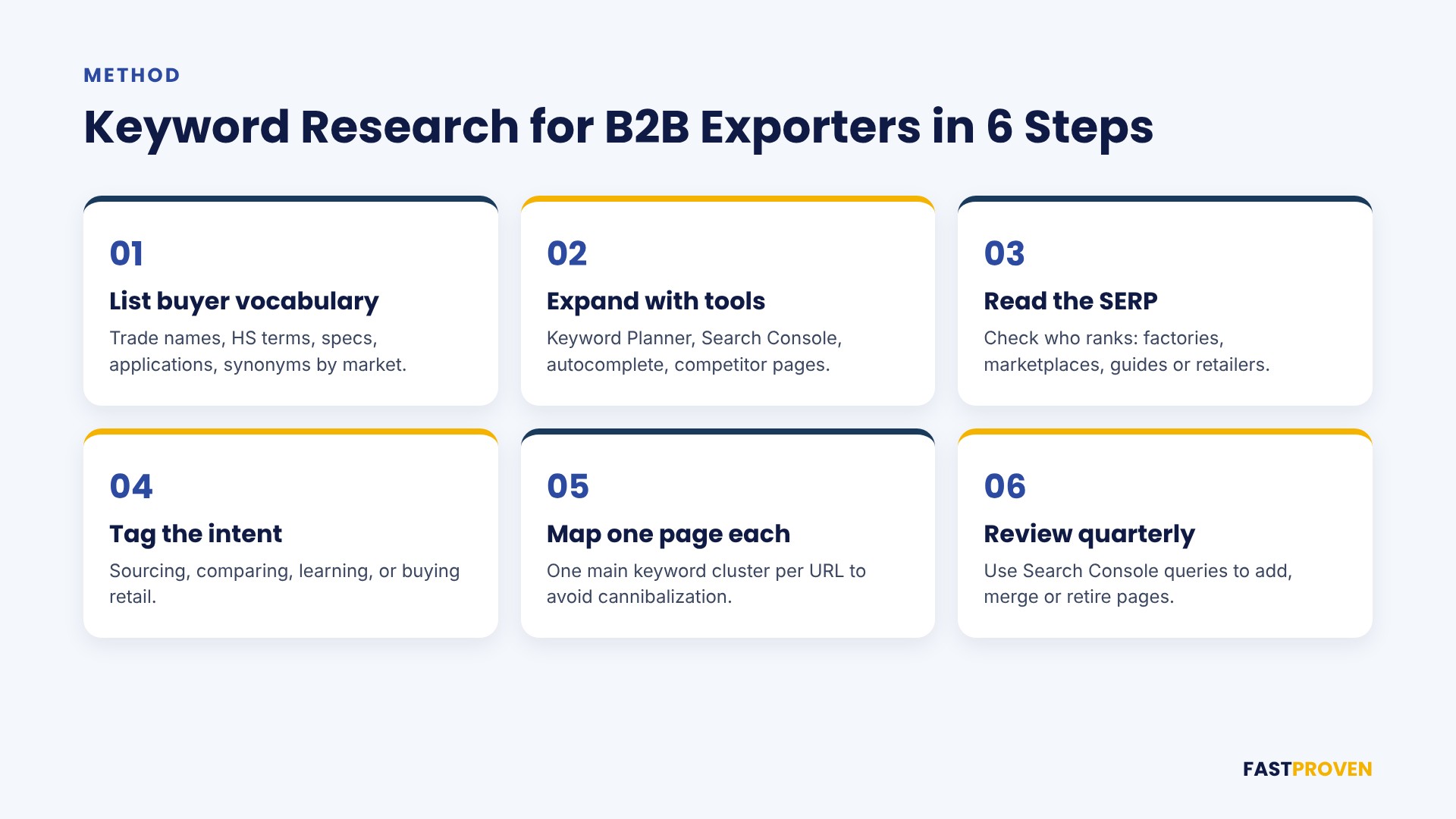
Step 1: Build a Buyer Vocabulary List
Start offline, with people rather than tools. Ask your sales team for the exact words buyers use in emails and RFQs. Read inquiries from the past year and highlight product names, specifications and applications. Look at your competitors’ websites in your target markets, distributor catalogues and trade association documents. Note the terms they use for your product, its materials, its standards and its typical uses.
Organize the list by product line. For each line, write down the main product names, technical attributes such as size, thickness, material and voltage, applications, relevant standards and certifications, and buyer role words like manufacturer, supplier, factory, wholesale, OEM and private label. This becomes the raw material for every later step.
Step 2: Expand the List With Tools
Now use tools to expand and validate. Google’s own Keyword Planner can suggest related keywords and estimate search volume, though full features require a Google Ads account with billing set up. Search Console shows which queries already bring impressions to your site, which is the most reliable data you have. Google autocomplete and the “People also search for” and related searches sections reveal how real people phrase questions. Paid tools such as Ahrefs or Semrush add competitor data and keyword difficulty estimates.
Remember that for niche industrial products, tools often report zero or very low volume for keywords that do bring business. Do not delete a keyword just because a tool shows “0 to 10”. If your sales team hears the term in real inquiries, it deserves consideration.
Step 3: Read the Search Results Page
Before deciding to target a keyword, search it yourself, ideally with a VPN or browser setting that matches your target market. Look at what ranks on the first page. Are the results factory websites, marketplace listings, retail shops, Wikipedia style explainers or buyer guides? The answer tells you what Google believes the searcher wants and what kind of page you need to compete.
If the first page is full of retail shops selling single units, a B2B category page may struggle there, and the keyword may not bring the buyers you want anyway. If the first page shows other manufacturers and marketplaces, a strong category page has a realistic chance. If it shows guides and explainers, an article will fit better than a product page.
Step 4: Tag Each Keyword by Intent
With results in mind, tag each keyword by intent. A simple four level system works well for exporters.
| Intent Type | Example Keywords | Best Page Type | Value for Exporters |
|---|---|---|---|
| Sourcing | silage film manufacturer China, OEM gym mat factory | Category page | Highest, direct supplier search |
| Specification | 750 mm silage stretch film 25 micron | Product page | High, buyer knows what they need |
| Comparison | PU vs PVC gym mat, black vs white silage film | Buyer guide article | Medium, builds trust early |
| Learning | how is silage film made, what is a thermal actuator | Educational article | Lower, but supports authority and links |
Keywords with retail intent, such as “buy one yoga mat near me”, are usually not worth targeting for a factory. Remove or deprioritize them, even if their volume looks attractive.
Step 5: Map One Keyword Cluster to One Page
Mapping is where most keyword research projects succeed or fail. Group closely related keywords into clusters that share the same intent, then assign each cluster to exactly one page. For example, “silage film manufacturer”, “silage stretch film supplier” and “bale wrap film factory” can belong to one category page. “Black vs white silage film” belongs to a separate guide.
When two or more pages target the same cluster, they compete with each other. This is called keyword cannibalization, and it is one of the most common problems we find on manufacturer sites with years of content. Search Console often shows impressions split across several similar URLs, none of which ranks well. The fix is to merge content into the strongest page and redirect the others. In one project with an agricultural film producer in northern China, consolidating overlapping articles into fewer, stronger pages was among the most effective changes we made.
A Worked Keyword Map Example
Here is a simplified example for a hypothetical manufacturer of gymnastics and sports mats. Notice how each page has a clear job and no two pages share the same main cluster.
| Page | Main Keyword Cluster | Supporting Terms |
|---|---|---|
| Category: gymnastics mats | gymnastics mat manufacturer | gymnastics mats supplier, gym mat factory China |
| Category: crash mats | crash mat manufacturer | landing mat supplier, safety crash mats wholesale |
| Product: folding panel mat | folding gymnastics panel mat | 4 panel folding mat, tri fold exercise mat |
| Product: 20 cm landing mat | 20 cm landing mat | 8 inch crash mat, thick gymnastics landing mat |
| Guide | PU vs PVC gym mats | best cover material for gym mats |
| Guide | how to choose crash mat thickness | crash mat thickness guide |
Once the map exists, it guides everything else: page titles, headings, internal links and new content ideas. Our article on product page SEO for manufacturers shows how to turn the product rows of a map like this into pages that rank and convert.
Step 6: Review and Update Quarterly
A keyword map is a living document. Every quarter, export the queries report from Search Console. Look for queries with many impressions but low clicks, which usually signal a title or snippet problem. Look for new queries that do not match any page yet, which may deserve a new guide or product page. And look for queries where two of your URLs appear alternately, a sign of cannibalization that needs fixing.
Also review with sales. Ask which products buyers are asking about more often and which markets are growing. If you are adding a new market, for example Latin America, keyword research for that market should start with local vocabulary, not translated English terms.
Regional Vocabulary: A Quick Reference
Regional differences can make or break a keyword list. The examples below are common in our projects, but always confirm with your own buyers and competitor research.
| Concept | Common in the US | Common in the UK and Commonwealth |
|---|---|---|
| Sports mats for landing | landing mats, crash pads | crash mats, safety mats |
| Heating systems | radiant floor heating | underfloor heating |
| Packaging film for bales | bale wrap, stretch wrap | silage wrap, bale film |
| Measurement | inches, feet, pounds | millimetres, metres, kilograms |
Where your buyers span several markets, include both terms naturally on the page, for example in the introduction and the specification table. Avoid creating separate pages for each synonym unless the markets are truly different and you plan proper localization.
Turning the Keyword Map Into a Content Calendar
A keyword map only creates value once pages are written or improved. The challenge for most factory teams is capacity: product managers are busy, writers need technical input, and photos depend on production schedules. A realistic content calendar turns the map into a sequence of small, finished tasks rather than one overwhelming project.
Start with the clusters closest to revenue. In most cases that means existing category pages for your best selling product lines, because they already have some authority and only need better content. Next come the product pages for your highest margin items. Buyer guides follow, prioritized by how often your sales team hears the question. A manufacturer with modest resources might plan something like this for the first quarter:
- Weeks 1 to 4: Rewrite three main category pages using the sourcing clusters from your map.
- Weeks 5 to 8: Upgrade six to ten key product pages with full specs, photos and FAQs.
- Weeks 9 to 12: Publish two or three buyer guides that answer comparison questions and link into those categories.
Assign each item an owner on the factory side who supplies technical facts and approves accuracy. That single step prevents the most common bottleneck we see, where finished drafts wait weeks for someone to confirm a tolerance or a certificate number. After the first quarter, compare Search Console data for the improved pages against the previous period, then plan the next batch based on what moved.
Common Keyword Research Mistakes Exporters Make
- Targeting only head terms. “Gym mat” is enormous and mostly retail. “Gymnastics mat manufacturer” is smaller and far more relevant.
- Translating Chinese product names literally. The result is often correct English that nobody searches.
- Ignoring Search Console. Your own query data is more accurate than any third party tool for your niche.
- Writing a new article for every keyword variation. This creates cannibalization. Cluster first, then write.
- Chasing volume over intent. High volume learning keywords rarely bring RFQs on their own.
- Never revisiting the list. Markets, products and buyer language change; your map should too.
If you also sell through marketplaces, keep in mind that platform search and Google search reward slightly different phrasing. Our comparison of Alibaba vs independent website strategies explains why your website pages should target broader buyer language, while marketplace titles can stay tightly focused on platform search terms. Pages built from a good keyword map also make the structure of a B2B website for manufacturers much easier to plan.
Frequently Asked Questions
How many keywords should an exporter target?
Think in clusters rather than single keywords. A manufacturer with five product lines might start with 15 to 30 clusters covering categories, key products and buyer guides, then grow from there.
Is low search volume a reason to skip a keyword?
Not in B2B. A keyword with low reported volume but strong sourcing intent can be very valuable. Use sales feedback and Search Console data alongside tool estimates.
Should we include “China” in our keywords?
Often yes for sourcing keywords, since many buyers deliberately search for Chinese suppliers. Use it naturally on category pages, but do not force it into every title.
Which tool is best for B2B keyword research?
No single tool is enough. Combine Keyword Planner, Search Console, Google autocomplete and competitor analysis, then validate with your sales team’s real inquiry language.
Conclusion: Let Buyers Choose Your Keywords
Keyword research for B2B exporters works best when it starts with how buyers actually talk, not with what your catalogue says. Build a vocabulary list from real inquiries, expand it with tools, read the search results, tag intent, map one cluster to one page and review every quarter. The result is a site where each page has a clear purpose and buyers find answers instead of near duplicates.
Your next step: collect twenty recent inquiries from overseas buyers, highlight every product term they used and compare that list with the titles on your website. Wherever the words do not match, you have found your first keyword opportunities. If you want help building a complete keyword map for your product lines, the Fastproven team works with manufacturers across several industries and can turn that list into a page plan.
This article was last reviewed and updated by the Fastproven Editorial Team on November 19, 2026, to ensure the information is accurate and relevant for readers.