
Google SEO for Chinese manufacturers is no longer a nice extra that sits behind trade shows and marketplace listings. When a purchasing manager in Germany, Texas or Dubai needs a new supplier, the first thing they usually do is open a browser and type something like “gymnastics mat manufacturer” or “thermal actuator supplier China”. Whatever appears on that first page becomes the shortlist. If your factory is not there, you are not part of the conversation, no matter how good your production line is.
This guide is written for factory owners, export managers and marketing teams in China who want a steady flow of overseas inquiries from Google without paying for every click. We will walk through how B2B buyers actually search, what a factory website needs technically, which pages carry the most weight, how long results really take and the mistakes we see again and again when auditing manufacturer sites. Where it helps, we also share lessons from our own manufacturer projects, described without client names.
Table of Contents
Why Google SEO Matters for Chinese Manufacturers Right Now
The simplest reason is reach. According to StatCounter Global Stats, Google handles roughly nine out of every ten searches worldwide in 2026, while Baidu, the engine most teams in China use every day, holds well under one percent of global search. Your domestic marketing instincts are tuned to an engine your overseas buyers almost never use. That gap is exactly where a lot of export leads leak away.
The second reason is cost structure. Marketplaces and trade shows charge you every year, and the moment you stop paying, the exposure stops too. A well built product page that ranks for “custom PU foam mats manufacturer” can keep bringing inquiries for years, with only light maintenance. That does not make SEO free, because good content, photos and technical work all cost money, but the value accumulates instead of resetting every January.
The third reason is trust. Professional buyers have been burned by trading companies pretending to be factories and by suppliers who disappear after the first order. A detailed website that shows your lines, your machines, your certificates and the people behind the business answers many of their doubts before the first email. In our experience, inquiries that come through organic search tend to be longer, more specific and more serious than generic “send me price list” messages, because the buyer has already done some homework on your pages.
How Overseas B2B Buyers Search for Suppliers
Before touching keywords or code, it helps to picture the buyer. Most B2B purchases involve more than one person and more than one search session. An engineer looks for specifications, a buyer looks for price ranges and MOQ, and a manager wants to know whether the company is real. Each of them types different words into Google, and each of them needs a different kind of page.
Typical search patterns we see in Search Console data for manufacturer sites include:
- Product plus role: “silage film manufacturer”, “manifold supplier”, “OEM yoga mat factory”.
- Product plus country: “HVAC valve China”, “made in China gym flooring”, “Chinese thermostat manufacturer”.
- Product plus specification: “25 micron silage stretch film”, “1/2 inch brass manifold 8 port”.
- Problem or application: “underfloor heating actuator not opening”, “best material for crash mats”.
- Comparison and evaluation: “PVC vs PU gym mat”, “Alibaba supplier vs factory direct”.
Notice that very few of these queries contain your company name. That is the point. Google SEO for a manufacturer is mostly about being found by people who do not know you yet. Your brand name will rank on its own once the site is indexed; the hard and valuable work is ranking for the product and problem terms that sit earlier in the buying journey.
Different Markets, Different Words
One detail many Chinese teams miss is regional vocabulary. A British buyer may search “sports hall crash mats”, while an American buyer types “gymnastics landing mats”. Australians say “manufacturer” but also “wholesaler” more often than you might expect. If your product names are direct translations from the Chinese catalogue, they may be technically correct but rarely searched. Spend time reading competitor sites from your target markets and the language buyers use in their RFQs; that vocabulary should shape your page titles and headings.
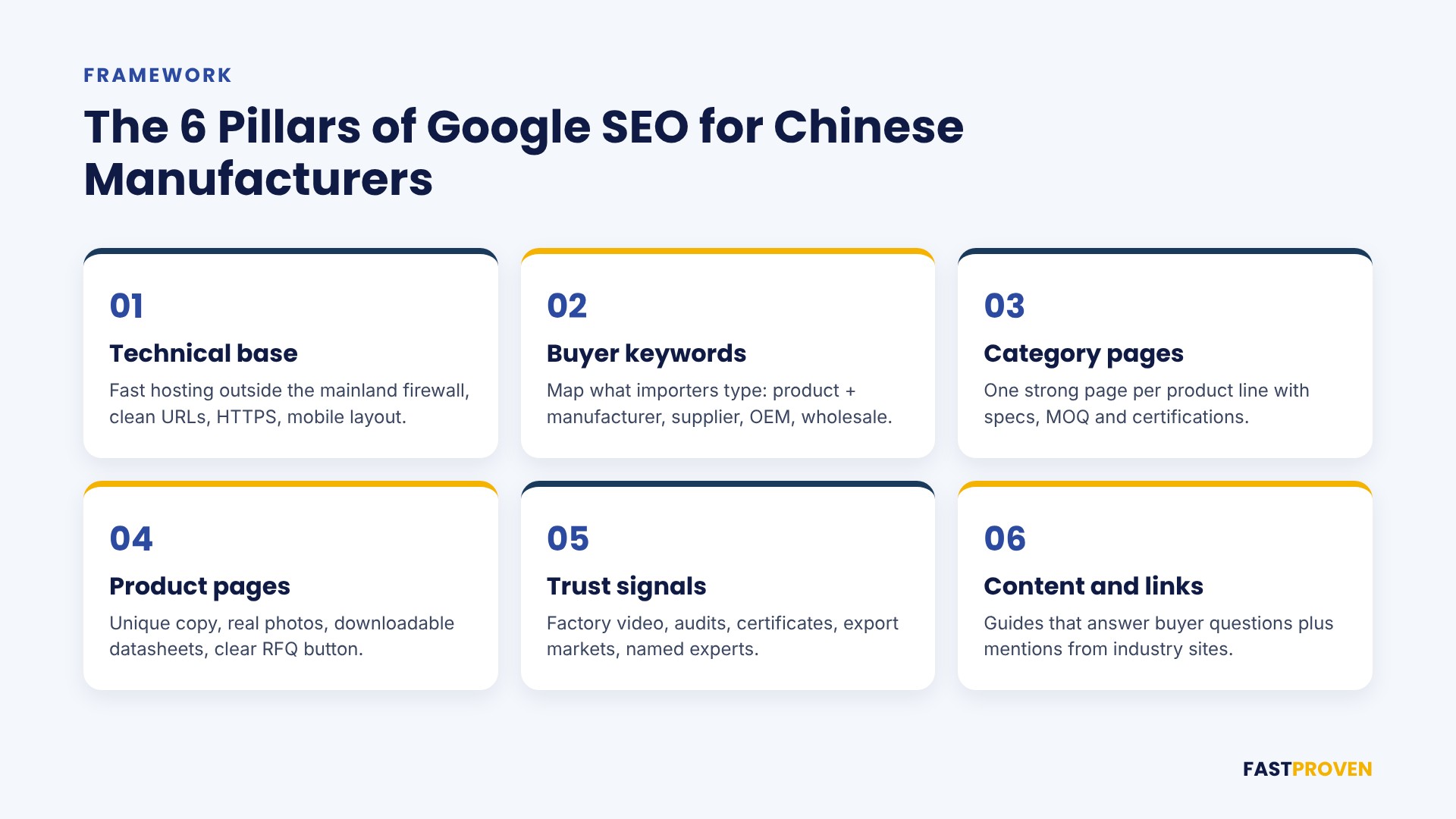
The Six Pillars of Google SEO for Chinese Manufacturers
Every factory is different, but the work almost always falls into six areas. Think of them as pillars: if one is weak, the whole structure leans. Below we explain each one in practical terms, with the questions you should ask about your own site.
1. Technical Base: Hosting, Speed and Crawlability
Your website must load quickly for visitors outside China, which usually means hosting it on servers in Hong Kong, Singapore, Europe or the United States rather than on the mainland. A site hosted abroad also avoids the ICP filing process that mainland hosting requires. Use HTTPS, a clean URL structure in English, and a mobile layout that does not hide key content. Make sure Google can crawl every important page: no accidental noindex tags, no product pages buried behind search boxes or JavaScript that never renders.
Something specific to teams in China: because Google services are blocked domestically, staff often cannot test the site the way overseas visitors see it. Someone on the team needs reliable access to Google Search Console and PageSpeed Insights, and you should test load times from the markets you sell to, not from the office in Ningbo or Foshan.
2. Buyer Keywords Mapped to Pages
Keyword research for a factory starts with your product lines, not with a tool. List every product family, then write down the words a foreign buyer would use, including materials, standards and applications. Tools such as Keyword Planner and competitor analysis help expand that list, but the most important step is mapping: one main keyword theme per page. When three pages all target “rubber gym flooring”, Google has to guess which one matters, and often none of them ranks well.
3. Category Pages That Act Like Mini Catalogues
For most manufacturers, category pages are the real money pages. A strong category page for “thermal actuators” explains what the product does, lists the models in a specification table, mentions MOQ and lead time, shows relevant certificates and links to each product page. Many factory sites make categories just a grid of thumbnails with no text, which leaves Google with nothing to understand and leaves buyers with nothing to compare.
4. Product Pages With Real Information
Product pages should have unique descriptions, real photos from your factory, a specification table, downloadable datasheets and a clear inquiry button. Copying the same 80 words across 40 product variants makes those pages look almost identical to search engines. It is better to have fewer, richer product pages than hundreds of thin ones.
5. Trust Signals and Experience
Google’s own guidance on helpful, people-first content places trust at the center of what it calls E-E-A-T: experience, expertise, authoritativeness and trustworthiness. For a factory, trust is shown through concrete evidence. Think factory tour videos, photos of the QC process, third party audit reports, certificates with issuer names and dates, the countries you export to, and real people with real roles who sign off on technical content.
6. Helpful Content and Earned Mentions
Finally, the site needs content that answers buyer questions and earns mentions from other websites. Guides like “how to choose a crash mat thickness” or “silage film color: black, white or green” attract early stage searches and show expertise. Links from industry associations, distributors, trade media and customer websites act as votes of confidence. Avoid buying bulk links from link farms; they rarely help and can trigger problems later.
Technical Setup Checklist for Factories in China
Before investing in content, it is worth checking the foundations. The table below summarizes the setup items we review first on any manufacturer site and why each one matters.
| Item | What Good Looks Like | Why It Matters |
|---|---|---|
| Hosting location | Server or CDN close to target markets, outside the mainland | Faster pages for overseas buyers, no ICP dependency |
| Domain | Short .com or country domain owned by the company, not the agency | Long term control and easier brand recall |
| HTTPS and security | Valid SSL, updated CMS and plugins | Trust signal and protection from hacked spam pages |
| Search Console | Verified property, sitemap submitted, reviewed monthly | Shows real queries, indexing issues and errors |
| URL structure | /category/product-name/ in English, no random IDs | Clear hierarchy for Google and readable links for buyers |
| Image handling | Compressed WebP or JPG, descriptive file names and alt text | Speed, image search visibility, accessibility |
| Inquiry tracking | Form submissions and email clicks logged with source | Lets you connect rankings to actual leads |
None of these items is glamorous, yet a surprising number of factory websites fail two or three of them. We have audited sites where the entire product catalogue was blocked from indexing for months because of one setting left over from development. Fixing basics like that sometimes produces faster gains than any amount of new content.
A Realistic Timeline for Results
One of the most common questions we hear from export managers is how long SEO takes. The honest answer is that it depends on your competition, the state of your current site and how much content you can produce, but most manufacturer projects follow a recognizable pattern.
| Period | Main Work | What You Can Expect |
|---|---|---|
| Months 1 to 3 | Audit, technical fixes, keyword mapping, rewrite of key category pages | More pages indexed, first impressions for long tail terms |
| Months 4 to 6 | Product page upgrades, trust pages, first buyer guides | Rankings on page two or one for specific product terms, early inquiries |
| Months 7 to 12 | Content expansion, internal linking, earning industry mentions | Stable traffic growth and a more predictable inquiry flow |
| Year 2 onward | Refreshing pages, new product lines, new markets or languages | Compounding results, lower cost per lead than paid channels |
If an agency promises first page rankings for “China manufacturer” in a few weeks, be careful. Fast movement is possible for niche long tail terms, but competitive head terms take sustained work. Our page on choosing a Google SEO agency in China goes deeper into the questions worth asking before you sign anything.
Lessons From Our Own Manufacturer Projects
We work with factories across sports equipment, HVAC components, agricultural films, industrial materials and cold chain devices. We keep client names private by default, because many manufacturers prefer that competitors do not see who handles their marketing. What we can share are the patterns that showed up across those projects.
A sports flooring manufacturer in Shandong came to us with a website that looked modern but had almost no text on its category pages. Each category was a gallery of photos with a contact button. We rebuilt the structure so every product line had its own page with specifications, use cases, MOQ and real factory and shipping photos. The lesson: design alone does not rank. Google needs words that match what buyers search, and buyers need details before they write.
An HVAC component maker in Zhejiang had a large catalogue spread across ten product lines, from valves to room thermostats. The challenge was not a lack of pages but overlap: several pages competed for similar terms. We consolidated, clarified which page owned which keyword, and added a reviewer bio and footer so technical content was clearly signed by a named expert at the company. The lesson: structure and accountability often matter more than volume.
An agricultural film producer in northern China had written many articles over the years, but several of them targeted the same topic with slightly different titles. Search Console showed impressions split across those pages. Merging and redirecting them into stronger single pages was one of the most effective steps in that project. The lesson: more articles are not always better; the right articles, with no duplication, are.
We share specific numbers privately during consultations, with the client’s permission, rather than publishing them. If you want to see examples relevant to your product category, you can request our company profile or reach out directly.
Common Mistakes That Hold Factory Websites Back
After many audits, certain mistakes appear so often that they are worth listing on their own. If you recognize several of these on your site, start there before commissioning new content.
- Hiding behind a trading company image. Generic stock photos and vague “we have rich experience” text make real factories look like middlemen. Show your own floor, machines and people.
- Thin or duplicated product text. Forty variants with the same paragraph give Google no reason to rank any of them.
- Machine translated English. Buyers notice awkward phrasing immediately, and it weakens trust even when the product is excellent.
- No prices, no MOQ, no lead times anywhere. You do not need to publish exact prices, but ranges and typical terms help buyers qualify themselves.
- Blog posts with no connection to products. Articles about company holidays or generic industry news rarely bring buyers. Write about questions that lead to your product pages.
- Agency owned domains or hosting. If the agency controls your domain, you can lose years of SEO work when the contract ends. Always register the domain in your company’s name.
- Ignoring Search Console. The data is free and shows exactly which queries bring impressions. Many teams never log in after setup.
How to Measure Whether SEO Is Working
Rankings are useful signals, but they are not the goal. The goal is qualified inquiries that turn into orders. A practical measurement setup for a manufacturer usually tracks four layers: impressions and clicks in Search Console, visits to product and category pages, inquiries by source, and finally the deals those inquiries turn into. Even a simple spreadsheet where the sales team marks each inquiry as “Google”, “marketplace”, “trade show” or “referral” is far better than guessing.
Look at trends over quarters rather than weeks. Search traffic moves with seasons, trade show calendars and Google updates. A dip in one month is normal; a steady decline over three months is a signal to investigate. Our older post on Google SEO for top-rank pages covers the fundamentals of how rankings work if your team is new to the topic.
Frequently Asked Questions
Do Chinese manufacturers need a separate website for Google, or is a marketplace store enough?
A marketplace store can bring early inquiries, but it does not build rankings or assets you own. Most exporters benefit from both: a marketplace for immediate visibility and an independent website for long term organic traffic and brand trust.
Can we do Google SEO from inside mainland China?
Yes, but someone on the team needs stable access to Google tools, and the website should be hosted outside the mainland for overseas speed. Many factories work with an external partner who handles the Google side while the internal team supplies product knowledge and photos.
How many articles do we need to publish?
There is no magic number. Start by fixing category and product pages, then add guides that answer real buyer questions. Ten strong, distinct articles usually beat fifty short ones on overlapping topics.
Is Google Ads better than SEO for manufacturers?
They solve different problems. Ads give instant visibility and are useful for testing keywords or launching new products. SEO builds lasting visibility at a lower long run cost. Many exporters use ads while SEO matures, then reduce ad spend as organic traffic grows.
Should we translate the website into other languages?
Only after the English site is solid. When you do add languages such as Spanish, German or Arabic, use proper localization with human review and correct hreflang setup, rather than automatic translation plugins.
Conclusion: Start With the Pages Buyers Actually Use
Google SEO for Chinese manufacturers comes down to a simple idea: make it easy for the right overseas buyer to find you, understand what you make and trust that you are a real, capable factory. The work is steady rather than flashy. Fix the technical base, map buyer keywords to clear category and product pages, show real evidence of your capabilities and publish content that answers the questions your sales team hears every week.
If you want a starting point this month, pick your three most profitable product lines and review their category pages against the checklist in this guide. Add specifications, MOQ ranges, real photos and a clear RFQ path. That single step often does more for inquiries than a full redesign. When you are ready for a deeper audit, the Fastproven team can review your site and share a prioritized plan, starting from what is already on our homepage and email at info@fastproven.com.
This article was last reviewed and updated by the Fastproven Editorial Team on November 17, 2026, to ensure the information is accurate and relevant for readers.