
Content marketing for manufacturers has a reputation problem. Many factory owners have seen agencies publish dozens of blog posts about “the future of the industry” or “five reasons to choose a reliable supplier”, watched traffic stay flat, and concluded that content does not work in B2B manufacturing. The conclusion is understandable but wrong. Content works very well for manufacturers; generic content does not. Engineers, sourcing managers and importers search constantly for specific answers, and the factory that answers them clearly earns both rankings and trust.
This guide explains what manufacturers should publish, where to find topics that buyers actually search for, which formats work best, how to turn engineers’ knowledge into articles without stealing their whole week, and how to connect content to inquiries. It complements our guide to keyword research for B2B exporters, which covers how to find and map the terms that this content should target.
Table of Contents
Why Most Manufacturer Blogs Fail
When we audit factory websites, the blog is often the weakest section. The pattern is familiar. Articles are short, written by someone outside the company with no technical knowledge, and focused on the supplier rather than the buyer. Topics are chosen because they sound professional, not because anyone searches for them. Posts rarely link to product pages, so even the occasional visitor has nowhere useful to go next. Over time, the blog becomes a collection of pages that neither rank nor convert.
Google’s Search Essentials summarize the alternative well: create helpful, people first content, and use the words people actually search for, especially in titles and headings. For a manufacturer, people first means writing for the engineer who needs to choose a material, the buyer who needs to understand MOQ and lead times, and the importer who wants to know what a certificate really proves.
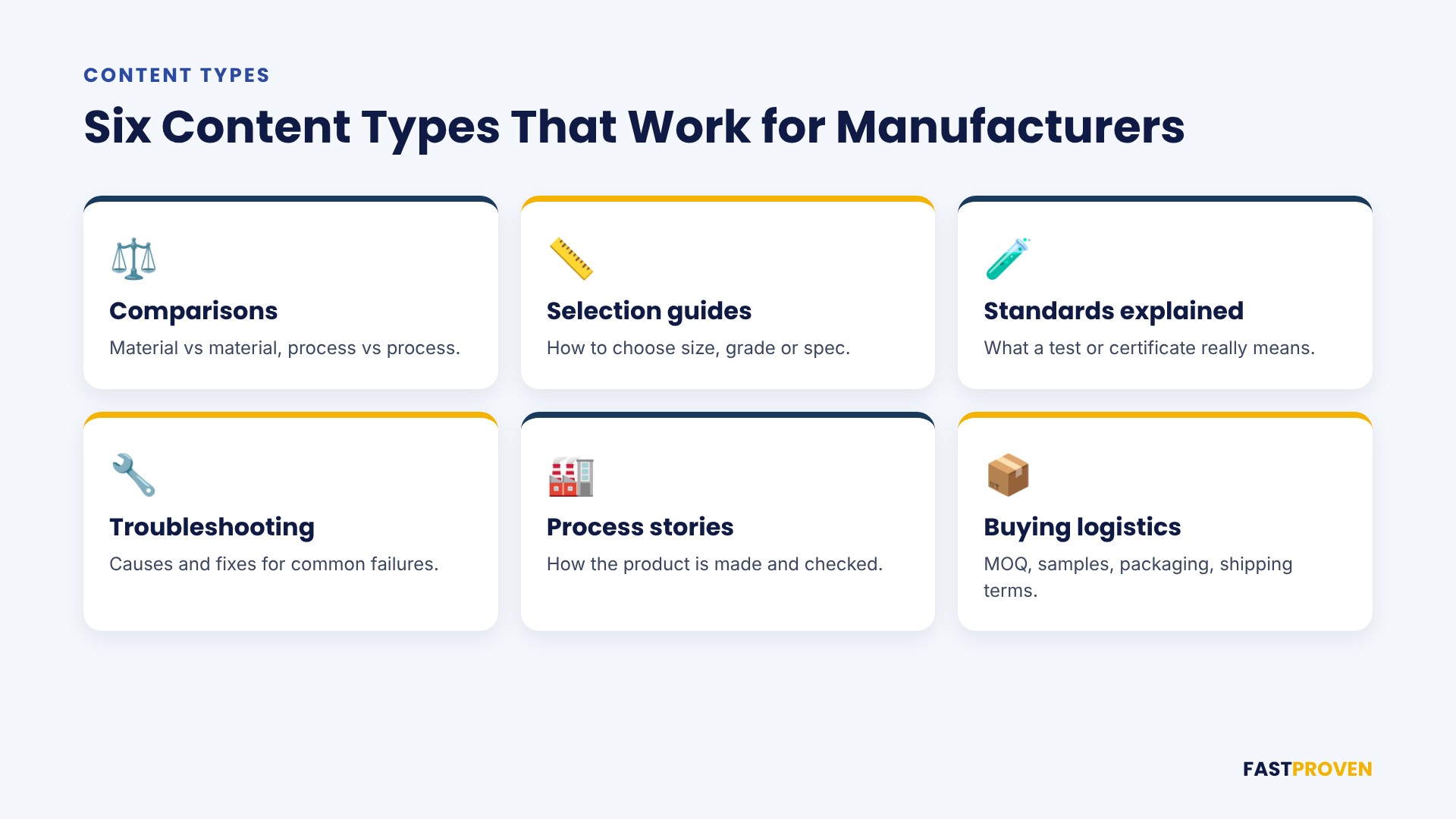
Six Content Types That Work for Manufacturers
Across industries as different as sports equipment, HVAC components and agricultural films, the same six content types consistently attract buyer searches and support sales conversations.
1. Comparisons
Buyers constantly compare: PU vs PVC covers, brass vs stainless steel manifolds, black vs white silage film, wax actuators vs motorized actuators. A comparison article that explains the differences honestly, including when the cheaper option is the better choice, builds credibility quickly. It also targets “vs” searches that often come from buyers close to a decision.
2. Selection Guides
“How to choose” articles help buyers pick the right size, grade or specification. Examples include how to choose crash mat thickness by drop height, how to size an underfloor heating manifold by number of zones, or how to choose stretch film width for a specific baler. These guides naturally lead to your category and product pages.
3. Standards and Certifications Explained
Many buyers, especially smaller importers, do not fully understand what a test standard covers. An article that explains what a specific test measures, what the results mean and what it does not prove positions your factory as knowledgeable and transparent.
4. Troubleshooting
Problem based searches such as “thermal actuator not opening”, “silage film tearing in cold weather” or “foam mat losing shape” come from people who already use the product. Some are current customers of competitors. A clear article on causes and fixes earns goodwill and sometimes a switch of supplier.
5. Process Stories
How is the product made, inspected and packed? Process content with real photos from your factory floor shows capability that stock images cannot. It answers the unspoken question every buyer has: is this a real manufacturer?
6. Buying Logistics
Articles about MOQ, sample policies, packaging options, shipping terms and lead times save your sales team countless emails. They also attract searches from buyers in the final stage of sourcing.
Where to Find Topics Buyers Actually Search For
The best topic ideas usually already exist inside your company. You just need a system to collect them.
- Sales inbox: Every repeated question from buyers is a potential article. Ask the sales team to forward interesting questions to a shared folder.
- Engineering and QC: Common customer complaints, test failures and specification misunderstandings make excellent troubleshooting and standards content.
- Search Console: Queries that bring impressions but no matching page show demand you are not yet serving.
- Google autocomplete and related searches: Type your product name and note how the suggestions phrase questions.
- Competitor and distributor sites: Look for topics they cover poorly or not at all.
- Trade shows: Write down the questions visitors ask at your booth. They are the same questions people type into Google.
Matching Content to the Buyer Journey
Not every article should push for an RFQ. Different content types serve different stages, and each should link to the next logical step.
| Buyer Stage | Typical Questions | Content Type | Next Step Link |
|---|---|---|---|
| Learning | What is it, how does it work? | Explainers, standards guides | Comparison or selection guide |
| Comparing | Which material or type is better? | Comparisons, selection guides | Category page |
| Shortlisting | Can this factory make what I need? | Process stories, case studies | Product pages and RFQ |
| Buying | MOQ, samples, lead time, shipping? | Buying logistics, FAQ articles | RFQ form or sales contact |
| Using | Why is this failing, how to maintain it? | Troubleshooting, maintenance guides | Replacement parts or upgrade products |
Every article should link to at least one relevant category or product page. Our guide to category page SEO for manufacturers explains how to make those destination pages strong enough to receive that traffic.
A Workflow That Respects Engineers’ Time
The biggest obstacle to good manufacturer content is access to expertise. Engineers know the answers but have no time to write, and writers have time but lack technical knowledge. The solution is a workflow that uses each person for what they do best.
- Pick a topic from the sources above and check that it maps to a keyword cluster without overlapping an existing page.
- Interview the expert for 20 to 30 minutes. Record the conversation. Ask how they would explain the topic to a new customer, what mistakes buyers make and what numbers matter.
- Write the draft from the interview, adding structure, examples and tables.
- Collect real photos of the relevant products, tests or processes.
- Technical review. The expert spends 15 minutes checking facts and numbers, not rewriting style.
- Publish and link from related categories and articles, and add a named reviewer if the company agrees.
This approach typically needs less than an hour of expert time per article, while producing content that reads as genuinely knowledgeable. It also builds a library of recorded expertise that can feed future articles, videos and sales materials.
Formats Beyond Blog Articles
Articles remain the backbone of manufacturer content, but other formats can carry the same knowledge further.
- Comparison tables and spec sheets that buyers download and forward internally.
- Short videos of tests, production steps or installation, embedded in relevant articles.
- Calculators or sizing tools for products with clear selection formulas.
- Glossaries of technical terms in your industry, linked from articles.
- Case studies of projects, named or anonymized with the customer’s agreement.
Choose formats that fit your buyers and your resources. A factory with a capable QC lab might publish test videos; a factory with strong engineers might build a simple sizing calculator. Consistency matters more than variety.
How Much Content Is Enough?
There is no magic number, and publishing frequency is less important than coverage. A useful benchmark is to aim for a set of articles that answers the main questions around each product line: one or two comparisons, one selection guide, one standards or certification explainer, one troubleshooting piece and one buying logistics article. For a factory with five product lines, that is twenty five to thirty articles, which can be built over six to twelve months at a steady pace of a few articles per month.
Quality control matters more than volume. One strong article that answers a question completely will usually outperform five thin articles on slight variations of the same topic. Thin variations also create cannibalization, where several pages compete for the same query and none ranks well.
A Sample Six Month Content Plan
To make the approach concrete, here is how a factory with two main product lines might plan its first six months. The example uses a hypothetical maker of gymnastics mats and crash mats, but the rhythm works for most industries. The goal is not volume; it is to cover the key questions around each line in a logical order, starting with the content closest to buying decisions.
| Month | Article 1 | Article 2 | Supporting Work |
|---|---|---|---|
| Month 1 | How to choose crash mat thickness | PU vs PVC gym mat covers | Link both guides from the category pages |
| Month 2 | Gymnastics mat MOQ, samples and lead times explained | How our mats are made and tested | Record a short QC video for the process article |
| Month 3 | Foam density explained for landing mats | Common reasons mats lose shape and how to prevent it | Interview the production manager for examples |
| Month 4 | Folding panel mats vs single piece mats | Packing and shipping gym mats by sea | Add packaging photos to product pages |
| Month 5 | Choosing mats for school gyms vs competition venues | Anonymized project story from a distributor order | Get customer approval for the project details |
| Month 6 | Review and update the first four articles | Fill one gap found in Search Console queries | Quarterly content review and merge check |
Notice that month six includes no brand new topic for one slot. Updating early articles with better examples, photos and links often delivers more than publishing another post. Notice also that each article is tied to supporting work, such as a video, photos or a customer approval, so content improves the whole site rather than living only on the blog.
Lessons From Our Manufacturer Content Work
We produce content for manufacturers in several industries, and we keep client names private by default. One pattern from an agricultural film producer is worth sharing: years of articles had been published with overlapping topics, and Search Console showed impressions split across several near duplicate pages. Consolidating them into fewer, stronger articles was more effective than writing new ones. With an HVAC component maker, adding a named technical reviewer at the company to each article, with a short bio page, made the content more credible and gave sales a resource they were proud to share with buyers.
The lesson across projects is simple. Content performs when it reflects real expertise, targets real buyer questions and connects clearly to products. It struggles when it is generic, unreviewed and disconnected from the catalogue.
Measuring Content Marketing Results
Measure content on three levels. First, visibility: impressions and clicks for each article in Search Console, and which queries it ranks for. Second, engagement and flow: how many readers move from articles to category or product pages. Third, business impact: inquiries that mention a topic, a product discussed in an article or that arrive after a buyer visited content pages. A simple field in your CRM or inquiry spreadsheet, such as “first page visited”, helps connect content with leads.
Review results quarterly. Update articles that rank on page two with better examples, tables and links. Merge articles that overlap. Retire or redirect content that is outdated and no longer useful. Content marketing is an asset that needs maintenance, not a stream of posts that are forgotten after publishing.
Common Mistakes in Manufacturer Content
- Writing about the company instead of the buyer’s problem.
- Publishing without technical review, which leads to errors that experienced buyers notice immediately.
- Using stock photos instead of real images from the factory.
- Not linking to products, leaving readers with no next step.
- Chasing trending topics unrelated to what you sell.
- Machine translated text that reads awkwardly to native English speakers.
Frequently Asked Questions
Can AI tools write content for manufacturers?
AI tools can help with structure, drafting and editing, but the facts, numbers and experience must come from your team. Unreviewed AI text tends to be generic and sometimes wrong, which damages credibility with technical buyers.
How long should manufacturer articles be?
Long enough to fully answer the question. Many effective technical articles fall between 1,500 and 3,000 words, but a short, precise answer can also work if the topic is narrow.
Should we publish news about our company?
Occasionally, yes, for trade shows, certifications or new product lines. But news posts rarely attract search traffic, so they should not replace buyer focused content.
How soon does content marketing bring inquiries?
Some articles attract searches within weeks, especially for niche topics. A steady flow of inquiries from content usually builds over six to twelve months of consistent publishing.
Conclusion: Publish What Your Sales Team Explains Every Week
Content marketing for manufacturers succeeds when it turns factory knowledge into answers buyers search for. Focus on comparisons, selection guides, standards explainers, troubleshooting, process stories and buying logistics. Source topics from your sales inbox and engineers, use an interview based workflow to respect their time, link every article to relevant products, and measure what leads to inquiries.
Your next step: ask your sales team for the ten questions buyers asked most often last month. Group them by product line, check which ones your website already answers, and turn the rest into your first content plan. For the bigger picture of how content fits with technical work and trust signals, revisit our pillar guide to Google SEO for Chinese manufacturers.
This article was last reviewed and updated by the Fastproven Editorial Team on November 22, 2026, to ensure the information is accurate and relevant for readers.