
A B2B website for manufacturers has one job that most corporate websites do not: it must convince a stranger on another continent to trust you with a production order worth thousands, sometimes millions, of dollars. That buyer cannot walk your factory floor, shake your hand or inspect a sample before deciding whether to send the first email. Your website is the stand-in for all of that. When it is vague, slow or full of stock photos, the buyer moves on to the next supplier in their browser tab.
This article is a practical blueprint. We go through the pages a manufacturer website needs, what each page should contain, how to design the RFQ path so serious buyers actually write to you, and which details separate a site that ranks and converts from one that simply exists. It builds on our broader guide to Google SEO for Chinese manufacturers, but here the focus is the website itself: structure, content and conversion.
Table of Contents
What Buyers Expect From a B2B Website for Manufacturers
Professional buyers are busy and skeptical. They often evaluate ten or more potential suppliers before shortlisting three, and they do much of that evaluation without contacting anyone. In practice, they are trying to answer five questions as quickly as possible. Do you actually make this product, or are you a trader? Can you meet our specifications and standards? Can you handle our volume and timeline? Are you a stable, real company? And how easy is it to start a conversation with you?
Every page on your site should help answer at least one of those questions. A homepage that talks about “win-win cooperation” and “high quality, competitive price” answers none of them, because every supplier says the same thing. A homepage that shows your three core product lines, your production capacity, the markets you export to and a factory video answers four of them in ten seconds.
It also helps to remember that the person reading your site may not be the person who signs the order. An engineer checks tolerances and materials. A purchasing officer checks MOQ, lead time and payment terms. A quality manager looks for certificates and inspection steps. A good B2B website for manufacturers gives each of them a clear path to the information they care about, without forcing them to email for basic facts.
The Core Pages Every Manufacturer Website Needs
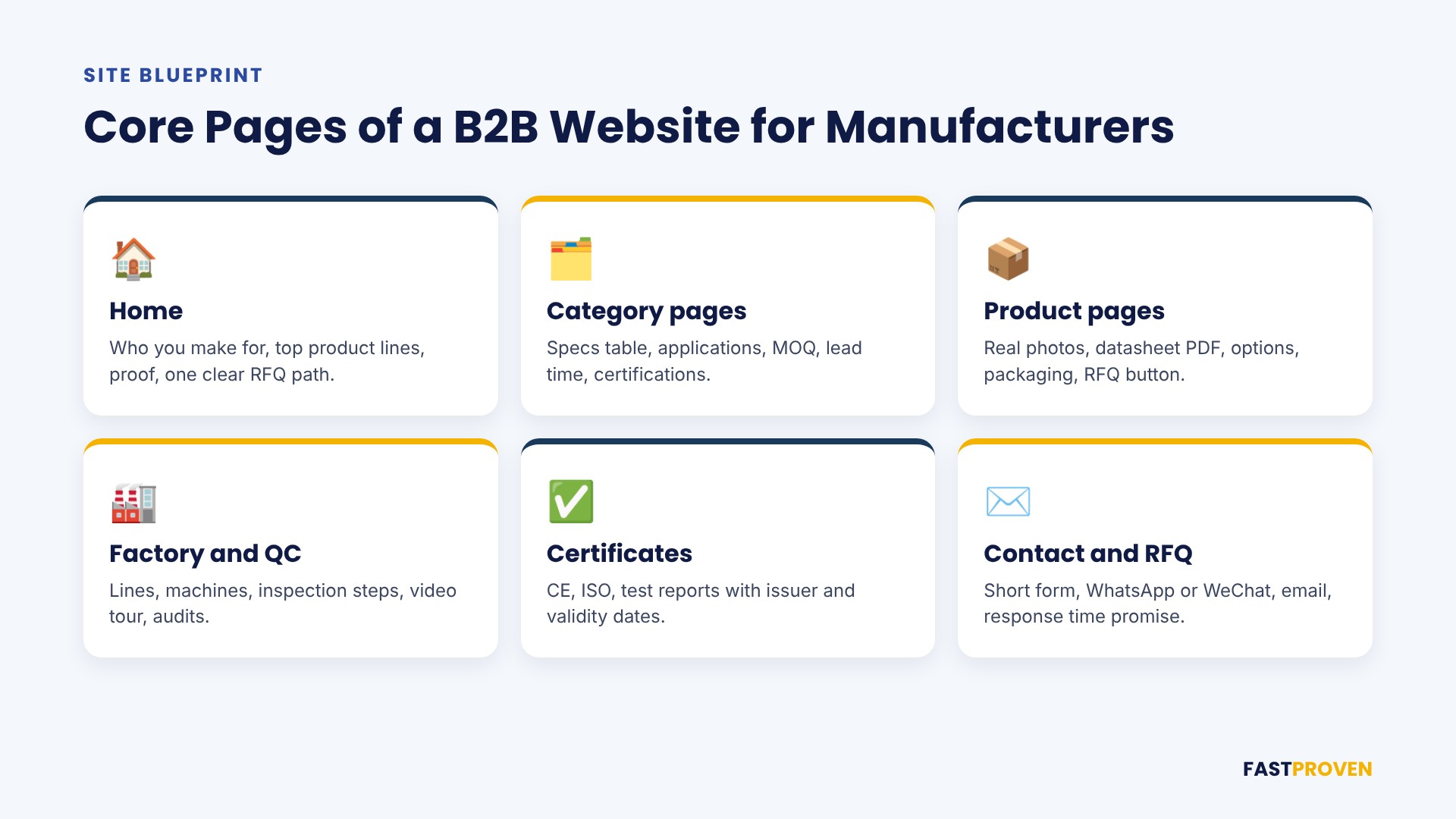
Below is the page structure we use as a starting point for factory websites. You can adjust it for your industry, but if any of these pages is missing, buyers will notice the gap.
Homepage: A Clear Summary in One Scroll
The homepage should state what you make and for whom in a single sentence at the top, for example “Manufacturer of PU and PVC gymnastics mats for schools, clubs and distributors worldwide”. Below that, link to your main product categories with short descriptions, show key numbers such as years in production, number of lines or monthly capacity, display certificates and export markets, and offer one obvious way to send an inquiry. Avoid sliders with five rotating banners; most visitors never see beyond the first one.
Category Pages: The Pages That Do the Heavy Lifting
For search traffic, category pages are usually the most valuable pages on a manufacturer site, because they match broad but commercial searches like “silage stretch film manufacturer” or “brass manifold supplier”. Each category page should include an introduction written for buyers, a specification or model comparison table, applications, MOQ and typical lead time, relevant certificates, and links to individual products. Think of it as a mini catalogue with context, not a grid of thumbnails.
Product Pages: Detail Without Duplication
Product pages handle specific searches and give engineers the detail they need. Use real photos, including close ups and packaging, a full specification table, available options for OEM or private label, a downloadable datasheet and a clear inquiry button. If many products differ only in size or color, consider one product page with a variant table rather than dozens of nearly identical pages.
Factory and Quality Control
This is where you prove you are a manufacturer. Show production lines, key machines, raw material checks, in process inspection and final testing. A short factory tour video, filmed on a normal working day, often does more than a polished corporate film. Include approximate numbers where you can share them, such as the number of production lines, machines or QC staff.
Certificates and Test Reports
List each certificate with the issuing body, scope and validity date, and make the documents viewable or downloadable. Buyers in regulated markets will check these details. A wall of logos with no context invites doubt; specific, verifiable documents remove it.
About Us With Real People
Introduce the founder, the export team and the technical lead with names, roles and photos. Buyers want to know who they will be dealing with. This page is also a good place to explain your history, export experience and the types of customers you serve, such as distributors, brand owners or project contractors.
Contact and RFQ
Keep the inquiry form short, show an email address and the messaging apps your team actually uses, and state a realistic response time. We cover the RFQ path in more detail below because it is where many sites lose leads that they worked hard to attract.
Page Checklist: What to Include on Each Page
The table below is a compact version of the blueprint. Use it to audit your current site page by page.
| Page | Must Include | Nice to Have |
|---|---|---|
| Homepage | One line value statement, main categories, proof numbers, RFQ button | Short factory video, export map, featured guides |
| Category page | Buyer focused intro, spec or model table, MOQ, lead time, product links | Application photos, comparison with other materials, FAQ |
| Product page | Real photos, spec table, options, datasheet, inquiry button | 360 view, packaging details, related products |
| Factory and QC | Lines, machines, inspection steps, real photos | Tour video, audit summaries, capacity by product |
| Certificates | Issuer, scope, validity, viewable files | Lab test reports by product |
| About Us | Company story, team names and roles, customer types | Timeline, exhibitions attended, partner logos with permission |
| Contact and RFQ | Short form, email, messaging app, response time | Office and factory addresses with maps |
Designing an RFQ Path That Buyers Actually Use
We regularly see factory websites that attract solid traffic but turn very little of it into inquiries. When we dig in, the problem is often the RFQ path rather than the traffic. The form is too long, the button is hidden at the bottom of the page, or the site asks for a phone number, company size, annual purchase volume and a CAPTCHA before a buyer can ask a simple question.
A good RFQ form asks only for what your sales team needs to give a useful first reply. In most cases that means name, email, country, the product of interest and a free text message. Optional fields like quantity or target price can help, but making them mandatory scares off early stage buyers who are still exploring. You can always ask more questions in your reply.
| Field | Required? | Reason |
|---|---|---|
| Name | Yes | Basic courtesy in the first reply |
| Business email | Yes | Main channel for quotes and documents |
| Country | Yes | Helps with shipping terms and certifications |
| Product or model | Yes, often prefilled | Routes the inquiry to the right salesperson |
| Message | Yes | Lets buyers explain specifications in their own words |
| Quantity | Optional | Useful for pricing, but not every buyer knows yet |
| File upload | Optional | Drawings or specs for custom orders |
Place an inquiry button near the top of every product and category page, not only at the bottom. Prefill the product name when someone clicks from a product page so the buyer does not have to type it. After submission, show a thank you message that states when they can expect a reply, and send an automatic confirmation email. Then make sure the sales team replies within one working day. Speed is a trust signal on its own.
Content That Makes a Factory Website Rank
Structure gets you halfway; content does the rest. Google’s SEO Starter Guide repeatedly emphasizes making pages useful and easy to understand for people first, and that principle fits manufacturer websites perfectly. Write category and product text in clear English that a buyer would use, answer the questions your sales team hears often, and include specifics such as materials, standards, dimensions and applications.
Beyond product pages, a small library of buyer guides can attract earlier stage searches and feed traffic into your categories. Examples include material comparisons, sizing guides, installation tips and explanations of standards. Each guide should link naturally to the relevant category or product page. A buyer who learns how to choose the right mat density from your guide is already halfway to asking you for a quote.
A Before and After Example From Our Work
One sports equipment factory in Shandong we worked with had a visually modern website, but its product categories were almost entirely image galleries. There were dozens of photos and very little text, no specification tables and only a contact page at the end of the menu. Buyers who landed on the site from Google had to guess what was available and then write a generic email to find out.
The rebuild focused on substance rather than decoration. Each product line received its own category page with a clear introduction, a specification table, typical applications and real photos from the production floor and the loading area. Product pages gained datasheets and inquiry buttons near the top. The company profile was rewritten around concrete facts the client was happy to share, such as years in production, number of production lines and machines. The site still looked modern, but now it also explained, proved and invited.
We keep client names private by default, and we only share performance figures privately with permission. The structural lesson, however, applies to almost every factory: a website that answers buyer questions on the page will outperform a website that only looks impressive.
Common Mistakes on Manufacturer Websites
- Building the site in Chinese first and translating later. Navigation, product names and copy end up awkward. Plan the English site around buyer vocabulary from the start.
- Using stock photos of factories that are not yours. Experienced buyers can spot them, and it undermines everything else on the page.
- Hiding all commercial information. No MOQ, no lead time, no payment terms anywhere. Ranges and typical terms help buyers decide to contact you.
- Too many pop ups and chat widgets. One unobtrusive chat option is fine; three overlapping windows on mobile are not.
- Slow, heavy pages. Uncompressed images and video backgrounds can make pages painfully slow for buyers on mobile networks abroad.
- The agency owns the domain. If your website domain is registered under an agency account, you risk losing years of work. Register it in your company’s name.
Frequently Asked Questions
How many pages does a B2B website for manufacturers need?
Most factories start with 15 to 40 pages: homepage, one page per product category, key product pages, factory and QC, certificates, about us, contact and a few buyer guides. Quality and clarity matter more than page count.
Should we show prices on our website?
Exact prices are rarely practical in B2B because they depend on volume, materials and shipping terms. Price ranges, MOQ and typical lead times are usually enough to help buyers qualify themselves and contact you.
Which platform is best for a factory website?
WordPress is a common choice because it is flexible, widely supported and easy to optimize for search. The platform matters less than structure, content, speed and who controls the account.
How long does it take to build a proper manufacturer website?
A focused site with good content typically takes six to twelve weeks, depending mostly on how quickly product information, photos and approvals come from the factory side.
Conclusion: Build for the Buyer Who Cannot Visit Your Factory
A strong B2B website for manufacturers replaces the factory visit that most buyers cannot make. It shows what you produce, proves you can deliver, introduces the people behind the company and makes it easy to start a conversation. Clear category pages, detailed product pages, honest factory and certificate pages and a short RFQ path do most of the work.
Your next step: open your own website on a phone, pretend you are a buyer from overseas, and try to find your MOQ, lead time, certificates and inquiry form for one product line in under a minute. Whatever slows you down is the first thing to fix. If you want an outside review, the Fastproven team handles website builds and SEO for exporters, and you can learn more about how we compare to other providers in our guide to choosing a Google SEO agency in China, or browse our company profile and contact us via the Fastproven homepage.
This article was last reviewed and updated by the Fastproven Editorial Team on November 17, 2026, to ensure the information is accurate and relevant for readers.