
The Alibaba vs independent website debate comes up in almost every conversation we have with Chinese exporters. Some factories have spent years on Alibaba.com and feel stuck paying more each year for the same visibility. Others have built a beautiful company website that receives almost no inquiries and wonder whether they should go back to the marketplace. Both groups are asking the same question in different ways: where should our export marketing budget go?
The honest answer is that this is rarely an either or choice. Marketplaces and independent websites do different jobs, attract buyers at different stages and carry very different risks. This article compares them across cost, lead quality, control, trust and long term value, then offers a practical framework for deciding how to split your effort. If you are new to search marketing, you may want to read our main guide to Google SEO for Chinese manufacturers first.
Table of Contents
How Alibaba and Independent Websites Generate Leads Differently
A B2B marketplace like Alibaba.com, Made-in-China.com or Global Sources works like a giant trade show that never closes. Buyers go there with sourcing intent, type a product name and see hundreds of suppliers side by side. Your listing competes directly with competitors on price, response rate, badges and paid placement. The platform owns the traffic, the search algorithm and the buyer relationship until a conversation moves off the platform.
An independent website works through search engines, referrals and direct visits. A buyer searching Google for “custom PU gymnastics mats manufacturer” may find your category page, read your specifications, watch your factory video and send an inquiry without ever seeing a competitor on the same screen. You own the domain, the content and every inquiry. The tradeoff is that traffic does not exist on day one; you have to earn it through SEO, content and sometimes advertising.
Google remains the dominant entry point for that second path. According to StatCounter Global Stats, Google handles close to 90 percent of worldwide searches in 2026. Many buyers who end up on Alibaba actually started on Google, typed a product query and clicked a marketplace result. When your own site ranks for those same queries, you intercept the buyer before they ever see a comparison grid.
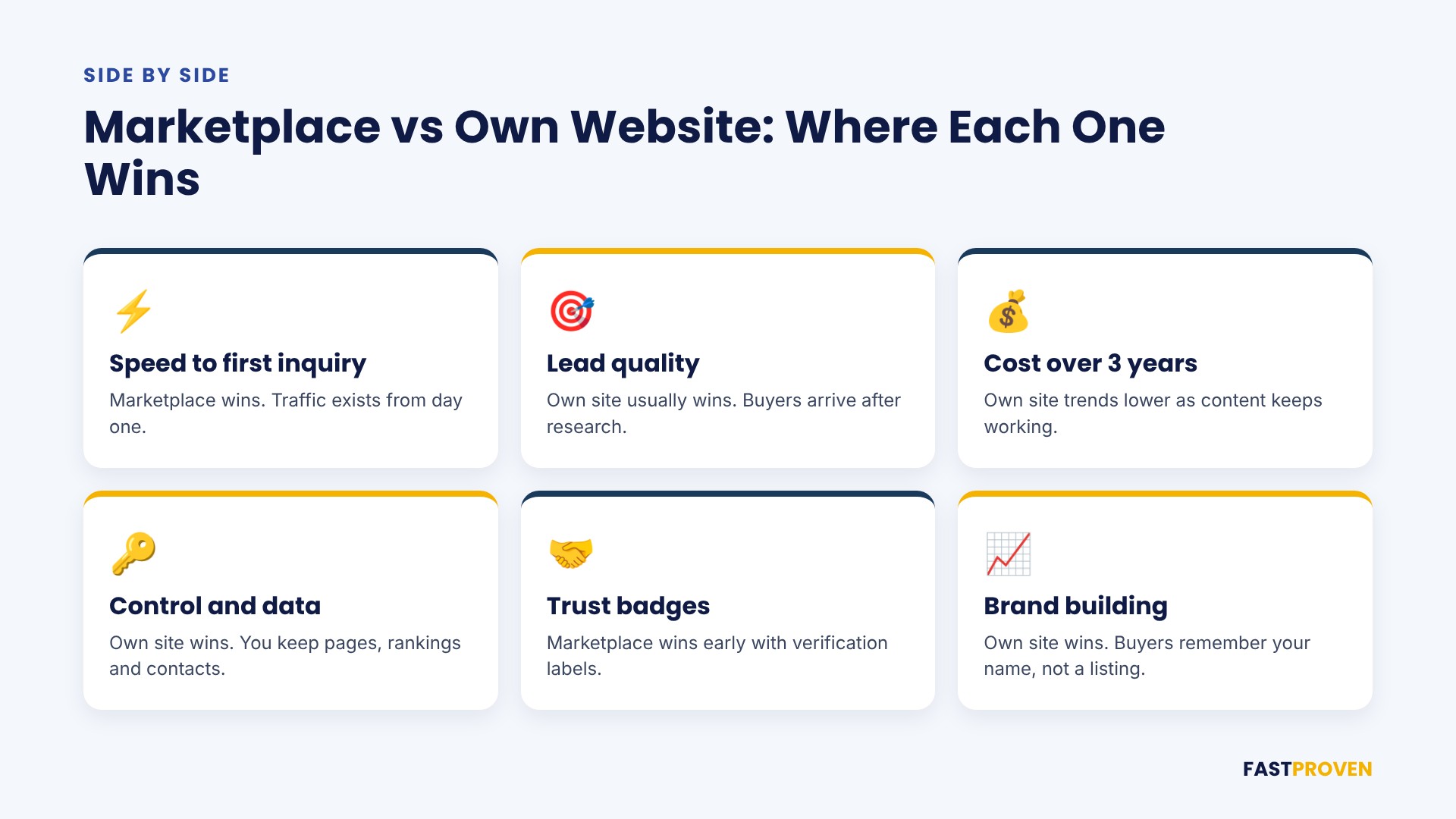
Alibaba vs Independent Website: Side by Side Comparison
The table below summarizes the main differences we see when advising manufacturers. Exact numbers vary by industry and region, but the pattern is consistent.
| Factor | Alibaba and Similar Marketplaces | Independent Website |
|---|---|---|
| Time to first inquiry | Fast, often within weeks of a paid membership | Slower, usually months while SEO builds |
| Typical inquiry style | Many short messages, frequent price checks | Fewer but more detailed inquiries |
| Competition on the page | Competitors shown right next to you | Only your company on your pages |
| Annual cost pattern | Membership plus keyword ads, repeats every year | Build cost plus content and maintenance, value accumulates |
| Control over design and content | Limited to platform templates and rules | Full control |
| Ownership of rankings | Platform owned, lost when you stop paying | Owned by you, persist with maintenance |
| Buyer data | Partial, platform keeps much of it | Complete, including analytics and contact history |
| Trust signals | Platform badges, verification, transaction history | Your own certificates, videos, team, case studies |
| Brand recall | Buyers remember “a supplier on Alibaba” | Buyers remember your company name |
The Real Cost of Selling on Alibaba
Membership fees are only the starting point. Alibaba offers tiered paid memberships, with Gold Supplier and Verified Supplier as the best known labels, and packages and prices vary by region. Alibaba’s own seller blog, writing for exporters in Southeast Asia, has cited roughly USD 4,700 per year for Gold Supplier and around USD 12,500 for Verified Supplier, which includes on site verification by inspection firms. Suppliers registered in mainland China apply through China specific membership packages with their own pricing, so it is worth requesting a current quote from your local account manager rather than relying on figures you see online.
On top of membership, most active suppliers spend on keyword advertising inside the platform to appear higher in search results. In competitive categories, this spend can exceed the membership itself. Then there is staff time: someone has to update listings, answer inquiries quickly to maintain response rate metrics and manage the store. None of this is wasted if the leads are profitable, but it is a recurring cost that resets every year.
The bigger hidden cost is dependency. When a platform changes its ranking rules, raises prices or penalizes a listing, your lead flow can drop overnight, and you have little leverage. Several factories we have spoken with describe this feeling as renting a shop in someone else’s mall: the foot traffic is real, but the landlord sets the rules.
The Real Cost of an Independent Website
An independent website has a different cost shape. There is an upfront investment in design, development, photography and content, followed by ongoing costs for hosting, maintenance, new content and possibly SEO support or advertising. In the first months, cost per lead is often higher than on a marketplace because traffic is still growing.
Over time, the curve usually bends the other way. A category page that ranks well keeps attracting buyers without additional payment per visit. Content you wrote two years ago can still bring inquiries today. The site becomes an asset that sits on your balance sheet in spirit, if not in accounting terms. The risk shifts from platform dependency to execution risk: if the site is poorly built or never updated, it will not perform no matter how much you spent on design.
A Simple Three Year View
To make the difference concrete, consider a hypothetical mid sized factory comparing the two paths over three years. The figures below are illustrative, not quotes, and your real numbers will depend on category and competition.
| Year | Marketplace Path | Independent Website Path |
|---|---|---|
| Year 1 | Membership plus ads; inquiries start quickly | Build and content investment; inquiries start slowly |
| Year 2 | Similar or higher spend to keep position; inquiry volume stable | Lower spend focused on content and maintenance; inquiries grow as pages rank |
| Year 3 | Spend continues; stopping means visibility drops quickly | Spend steady or lower; established pages keep producing leads |
The point is not that one path is always cheaper. It is that marketplace costs stay roughly flat or rise, while website value tends to compound when the work is done well. That is why many experienced exporters treat the marketplace as a lead source to manage and the website as an asset to build.
Lead Quality: What Our Projects Showed
Across the manufacturer websites we have worked on, from sports flooring to HVAC components and agricultural films, a pattern repeats. Inquiries from organic search tend to reference specific products, specifications or applications, because the buyer has already read the relevant page. Many marketplace messages, by comparison, are short requests for a price list sent to many suppliers at once. Both types can lead to orders, but sales teams consistently tell us they spend less time filtering website inquiries.
We keep client names and performance figures private by default and only share them in consultations with the client’s permission. What we can say publicly is that the factories who saw the most benefit from their own sites were the ones who invested in real content: detailed category pages, factory and QC proof, and answers to buyer questions. Websites that were mostly design with little information performed no better than a marketplace listing, and sometimes worse.
When Alibaba Makes More Sense
- You are new to exporting and need inquiries quickly to learn what overseas buyers want.
- Your product is highly standardized and competes mainly on price, where buyers compare dozens of suppliers anyway.
- Your target buyers are small importers who prefer platform protections such as trade assurance.
- You lack the resources to produce website content consistently for at least a year.
When an Independent Website Makes More Sense
- You sell customized, technical or OEM products where buyers need detail before they trust you.
- You target distributors, brand owners or project buyers who research suppliers carefully.
- You want to build a brand rather than compete listing by listing.
- You are tired of rising platform costs and want to reduce dependency over time.
The Hybrid Strategy Most Exporters Should Use
For most factories, the smartest approach is to run both channels with clear roles. Keep a marketplace presence for immediate visibility, but treat it as one channel among several, not the foundation of your business. At the same time, build an independent website that gradually takes over a bigger share of high quality leads. Our guide to the B2B website for manufacturers covers which pages to build first.
- Audit your current marketplace leads. Which products bring profitable orders? These are your first website priorities.
- Build strong category pages for those products on your own site, with richer information than your marketplace listings.
- Link both ways where allowed. Mention your website in company profiles and email signatures, and show your marketplace badges on your site if they help trust.
- Track source for every inquiry. Without this, you cannot shift budget with confidence.
- Review every six months. As organic leads grow, consider reducing marketplace ad spend while keeping the membership if it still pays off.
Questions to Ask Before Renewing Your Marketplace Membership
Renewal season is the best moment to step back and look at the numbers honestly. Many factories renew automatically because the account manager calls, the badge looks good, and nobody has time to analyze the past year. A short review with your sales team can save a meaningful part of the budget or, at the very least, confirm that the spend is justified.
- How many orders, not inquiries, came from the platform last year? Count confirmed orders and their gross margin. Inquiry counts alone flatter every channel.
- What did each order really cost? Add membership, keyword ads and the staff hours spent answering platform messages, then divide by the number of orders.
- Which products drove those orders? If most profit came from two product lines, you may be paying to promote many listings that never convert.
- How many of those buyers reordered directly? Repeat buyers who now email you directly show that the platform did its job as an introduction channel.
- What would happen if you paused ads for one month? Some suppliers test this in a slow season to see how much of their visibility depends on paid placement.
- Does your own website already rank for any of the same products? Check Search Console. Where your site is close to page one, a little more content work may replace part of the ad spend.
None of these questions requires special software. A spreadsheet and an honest hour with the sales manager are usually enough. The goal is not to quit the marketplace by default, but to make the renewal a decision rather than a habit.
Common Mistakes When Choosing Between Them
- Copying marketplace listings to your website word for word. Duplicate content gives buyers and Google no reason to prefer your site.
- Abandoning the marketplace too early. Cutting a working lead source before your site produces leads can hurt cash flow.
- Treating the website as a one time project. A site that is never updated rarely outperforms an active marketplace store.
- Measuring only volume. One hundred low quality inquiries can be worth less than ten qualified ones.
Frequently Asked Questions
Is Alibaba still worth it for Chinese manufacturers?
For many factories, yes, especially for standardized products and early export stages. The key is measuring profitability per lead rather than assuming the membership pays off.
Can an independent website replace Alibaba completely?
It can for some manufacturers, particularly those with technical or customized products and strong content. Most exporters, however, benefit from keeping both and adjusting the balance over time.
How long before an independent website brings regular inquiries?
With consistent work, many manufacturer sites see early inquiries within four to six months and a more predictable flow within a year, depending on competition and content quality.
Should my website and Alibaba store use the same product descriptions?
No. Write richer, unique content for your website. Your marketplace listings can stay shorter and focused on platform search terms.
Conclusion: Rent Visibility, Build an Asset
The Alibaba vs independent website question has a practical answer: use the marketplace to rent visibility while you build an asset you own. Alibaba and its competitors deliver fast exposure but keep control and charge every year. An independent website takes longer to grow but gives you rankings, data and brand recognition that stay with your company.
Your next step: list your three most profitable product lines from marketplace orders, then check whether your own website has a detailed, unique page for each one. If not, those three pages are your starting point. When you want help planning the transition, our team has supported factories across several industries, and you can read how we work in our guide to choosing a Google SEO agency in China or contact us through the Fastproven homepage.
This article was last reviewed and updated by the Fastproven Editorial Team on November 18, 2026, to ensure the information is accurate and relevant for readers.