
Website hosting for Chinese exporters is one of those decisions that seems purely technical until it starts costing orders. A factory in Dongguan or Ningbo picks a fast local server because the website loads instantly in the office. Months later, the sales team hears from a distributor in Germany that the product pages take ages to open, the inquiry form sometimes times out, and the catalogue PDF never finishes downloading. The site was fast for the people who built it, not for the people it was built to sell to.
This article explains how to choose hosting for an export website. We compare mainland servers, Hong Kong, Singapore, Europe and the United States, explain where CDNs fit, cover the ICP question, and give a practical decision framework. It builds on our guide to technical SEO for manufacturer websites, where hosting is one of the foundations that affects speed, crawling and reliability.
Table of Contents
Why Hosting Location Matters for Export Websites
Every time a buyer opens a page, their browser requests files from your server. The farther the server, and the more network borders the data crosses, the longer each request takes. For a page with dozens of images, scripts and fonts, small delays add up quickly. Buyers do not see the cause; they only feel a slow, unreliable website, and slow websites lose trust.
Speed also matters for search. Google uses page experience signals, including Core Web Vitals, as part of how it evaluates pages. According to web.dev’s Core Web Vitals guidance, a good experience means the largest content element loads within 2.5 seconds, interactions respond within 200 milliseconds, and layout shifts stay at 0.1 or below, measured at the 75th percentile of real visits. A server on the other side of the world makes those targets harder to hit, especially on mobile networks.
Finally, hosting affects how Googlebot crawls your site. Google’s crawlers mostly operate from data centers outside China. If your server responds slowly or inconsistently to those requests, Google may crawl fewer pages, and new products take longer to appear in search. A responsive server is a quiet but real advantage.
The Main Hosting Options for Chinese Exporters
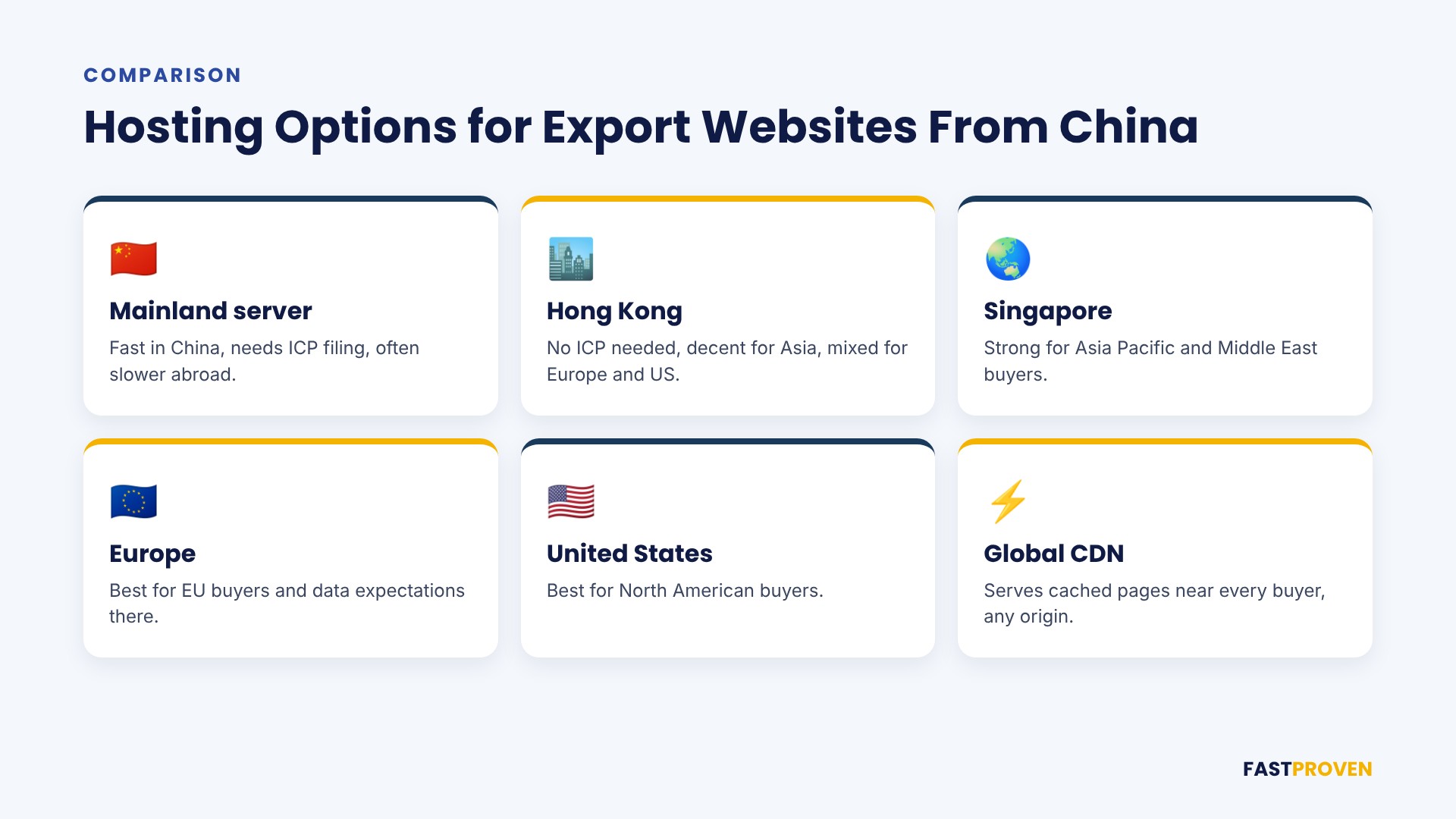
Each hosting location has strengths and tradeoffs. The right choice depends on where your buyers are, whether you also serve domestic Chinese customers, and how much technical support you have.
Mainland China Servers
Hosting inside mainland China gives excellent speed for domestic visitors and works well with Chinese CDN providers. However, websites hosted on mainland servers must complete ICP filing with the authorities before going live, which requires a registered Chinese entity and takes time. More importantly for exporters, international connectivity from mainland data centers can be inconsistent, and overseas buyers often experience slower load times, especially during peak hours. For a site whose main audience is abroad, mainland hosting is usually not the first choice.
Hong Kong
Hong Kong is a popular compromise. No ICP filing is needed, connectivity to mainland China is reasonable, and access for buyers in Asia is generally good. For buyers in Europe and the Americas, performance varies by provider and route. Hong Kong hosting works well for factories that sell heavily in Asia or want a single site reachable both domestically and abroad, though domestic access can still fluctuate.
Singapore
Singapore offers strong connectivity across Southeast Asia, South Asia, Australia and the Middle East. Many global cloud providers have major data centers there. For exporters whose buyers concentrate in ASEAN, India, the Gulf or Oceania, Singapore is often a solid origin location.
Europe
If your main buyers are European distributors and brand owners, hosting in Frankfurt, Amsterdam or London puts your site close to them. European buyers also tend to care about data handling, so a European origin can align with expectations around privacy, even though legal requirements depend on what data you collect and how.
United States
For North American buyers, a US data center, often on the West or East Coast depending on your customer base, gives the best baseline speed. Many popular managed WordPress hosts run primarily from US locations.
Where a CDN Fits In
A content delivery network stores copies of your static files, and often whole cached pages, on servers around the world. When a buyer in Spain opens your site, the CDN serves files from a nearby node rather than from your origin server in Singapore or the US. For most export websites, a good CDN matters more than the exact origin location, because it brings content close to every buyer at once.
A CDN does not fix everything. Pages that cannot be cached, such as form submissions or logged in areas, still travel to the origin. Poorly optimized pages remain heavy no matter how close the server is. And some CDN features for mainland China delivery require ICP filing. Think of the CDN as an accelerator on top of a sensible origin choice, not a substitute for a lean website.
Comparing Hosting Choices at a Glance
| Option | Best For | ICP Filing | Watch Out For |
|---|---|---|---|
| Mainland server | Factories that mainly sell domestically | Required | Slower and less predictable for overseas buyers |
| Hong Kong | Asia focused exporters, mixed domestic and export audience | Not required | Variable speed to Europe and the Americas |
| Singapore | ASEAN, South Asia, Middle East, Oceania buyers | Not required | Farther from European and American buyers without CDN |
| Europe | EU and UK distributors and brands | Not required | Slower for Asia without CDN |
| United States | North American buyers | Not required | Slower for Asia and Middle East without CDN |
| Origin plus global CDN | Exporters with buyers in many regions | Not required outside mainland delivery | Configuration, cache rules, uncached pages |
A Practical Decision Framework
Rather than debating providers endlessly, answer four questions in order. Your answers usually point to a clear choice.
- Where do most of your profitable buyers come from? Look at last year’s orders and inquiries by country, not at where you hope to sell someday.
- Do you need the same site to serve domestic Chinese customers? If yes, consider a separate Chinese site hosted in the mainland with ICP, and keep the export site abroad.
- How much technical support do you have? Managed hosting with built in caching, backups and security reduces risk for teams without an in house developer.
- Can you add a CDN? If your buyers are spread across several continents, choose the origin closest to the largest group and let the CDN cover the rest.
For many of the export websites we work with, the result is similar: an origin server in Singapore, Europe or the US, managed WordPress hosting with server side caching, and a global CDN in front. Domestic Chinese marketing, when needed, runs on a separate site and platforms better suited to Baidu and local channels.
Hosting Features That Matter More Than Price
Cheap shared hosting can look attractive when you compare monthly fees, but for a website that generates export inquiries, a few hours of downtime during a buyer’s visit can cost more than a year of hosting. When comparing providers, look beyond price at the features that protect your leads.
- Server response time. Ask for or test time to first byte from your target markets.
- Automatic backups. Daily backups stored separately, with easy restore.
- Security. Firewall, malware scanning and quick patching. Hacked factory sites often get injected with spam pages that damage rankings.
- Free SSL. HTTPS should be standard and renew automatically.
- Staging environment. A safe copy for testing changes before they go live.
- Support in a language your team uses. Fast, clear answers when something breaks.
- Account ownership. The hosting account should be registered to your company, not to a freelancer or agency.
Do Not Forget Business Email and DNS
Hosting decisions often focus on the website and forget the email that sits behind it. For exporters, email is where inquiries become quotes, samples and contracts. If your quotation emails land in a buyer’s spam folder, the speed of your website hardly matters. Many factories use email on the same cheap shared server as the website, or rely on personal free email addresses for export sales, and both choices create risk.
A safer setup separates the two. Keep the website on proper web hosting and use a dedicated business email service for your domain. Configure SPF, DKIM and DMARC records in your DNS so receiving servers can verify that emails really come from your company. Make sure the contact form sends notifications through an authenticated service rather than the server’s default mail function, which is a common reason why form inquiries never arrive. Test by submitting your own form from a phone and checking that the message reaches the sales inbox within a minute.
DNS itself deserves attention too. Use a reputable DNS provider, keep the login details under company ownership, and document which records point where. When something goes wrong during a hosting move, clear DNS records and access are what allow you to fix it in minutes instead of days.
Speed Is Not Only About the Server
Even with ideal hosting, a heavy website will feel slow. On factory sites, the most common speed killers are not the server at all: uncompressed product photos straight from a camera, homepage background videos, sliders with many large images, and too many plugins loading scripts on every page. A good hosting setup gives you headroom, but the website itself must be lean.
Practical steps include converting images to modern formats such as WebP while keeping the resolution buyers need to inspect details, lazy loading images below the fold, replacing autoplay video with a click to play poster, and removing scripts that do not earn their place. These changes often produce bigger improvements than switching hosts.
Migrating to Better Hosting Without Losing Rankings
Moving a website to a new host does not have to affect SEO, as long as the URLs stay the same and the site works correctly after the move. Plan the move for a quiet period, take a full backup, set up the site on the new server, test it using a temporary address or hosts file, then switch DNS. Lower the DNS time to live a day before so the change spreads quickly.
After the switch, check that HTTPS works, that forms send correctly, that redirects still function and that Google Search Console reports no new errors. If you are changing domains or URL structures at the same time, treat it as a full migration with redirect mapping, which is a larger project than a simple host change.
What We See in Exporter Websites
In our work with manufacturers across China, from sports equipment to HVAC components and agricultural films, hosting problems often hide behind other complaints. A client reports that “Google does not like our site” or “buyers say the form does not work”, and the root cause turns out to be a slow or overloaded server, or a host located far from the main market. We keep client names private, but a common pattern is a site built by a local developer on mainland hosting, fast in the office and noticeably slower for buyers abroad. Moving the export site to an overseas origin with a CDN, while keeping URLs unchanged, is usually a straightforward fix.
The broader lesson is to test your website from where your buyers are. Free tools let you check load time from different cities. Ten minutes of testing from Frankfurt, Dallas and Dubai often tells you more than any hosting brochure.
Frequently Asked Questions
Do I need ICP filing for an export website?
Only if the website is hosted on servers in mainland China. Export websites hosted in Hong Kong, Singapore, Europe or the US do not require ICP filing.
Is Hong Kong hosting good enough for European buyers?
It can be acceptable, especially with a CDN, but European buyers will usually get better performance from a European origin or a well configured global CDN.
Will changing hosting improve my Google rankings?
Hosting alone rarely moves rankings much, but a faster, more reliable server improves user experience and crawling. If your current host is slow or unstable, upgrading removes a barrier that holds other work back.
Should my domestic and export websites be the same site?
Often not. Domestic Chinese search and overseas Google search have different requirements. Many factories run a Chinese site hosted in the mainland and a separate English site hosted abroad.
Conclusion: Host Where Your Buyers Are
Website hosting for Chinese exporters comes down to a simple principle: put your website close to the people you want to sell to, then add a CDN to reach everyone else. Mainland hosting suits domestic sales; Hong Kong suits mixed or Asia focused audiences; Singapore, Europe and the US suit export markets in their regions. Reliable support, backups, security and company ownership of the account matter as much as location.
Your next step: test your current website’s load time from your top three buyer countries. If any of them shows slow results, review your hosting location and CDN setup before investing in new content. When you are ready to plan a move or a rebuild, the Fastproven team can help you choose a setup that fits your markets, as part of building a stronger B2B website for manufacturers. You can also start from our pillar guide to Google SEO for Chinese manufacturers.
This article was last reviewed and updated by the Fastproven Editorial Team on November 21, 2026, to ensure the information is accurate and relevant for readers.